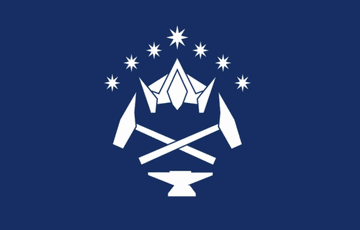
 Khuzdul (Dwarvish)
1. Introduction & History
Khuzdul is the secret language of the Dwarves in J.R.R. Tolkien's Middle-earth, heard in The Lord of the Rings and The Hobbit and glimpsed across his wider writings. Within the legendarium it was devised not by the Dwarves themselves but by their maker, the Vala Aulë — whom the Dwarves call Mahal — and taught to the Seven Fathers of the Dwarves at their awakening. Because it was a made language given whole, the Dwarves guarded it as a treasure: they almost never spoke it before outsiders, took public 'outer' names from the languages of Men (Gimli, Balin and Thorin are Old Norse names), and kept their true Khuzdul names so private that they did not even inscribe them on their tombs.
That secrecy has a real-world consequence: Khuzdul is one of the most sparsely attested of Tolkien's languages. Where Quenya and Sindarin each have thousands of published words, Khuzdul has roughly one hundred words, names and phrases scattered through The Lord of the Rings, The Silmarillion, The History of Middle-earth and the linguistic journals. Everything else a modern learner meets is Neo-Khuzdul — reconstruction and invention built on top of Tolkien's fragments, most famously the film Dwarvish that linguist David Salo created for Peter Jackson's Lord of the Rings and Hobbit trilogies, and the extensive community grammar and lexicon maintained by the fan scholar known as The Dwarrow Scholar. This guide teaches both layers and always tells you which one you are standing on. [Attested corpus size and secrecy: High confidence. Neo-Khuzdul details: fan sources, Medium confidence.]
The most famous Khuzdul in the books: the battle-cry Baruk Khazâd! Khazâd ai-mênu! ('Axes of the Dwarves! The Dwarves are upon you!'), the inscription on Balin's tomb in Moria — Balin Fundinul uzbad Khazad-dûmu, 'Balin son of Fundin, Lord of Moria' — and the great place-name Khazad-dûm itself, 'the Delving of the Dwarves'. Gandalf also cites the older name of Moria's west-gate inscription and mountain names like Barazinbar, Zirakzigil and Bundushathûr, which Tolkien glossed element by element.
2. A Semitic-Style Language: the Radical System
Tolkien stated that he constructed Khuzdul 'to be Semitic' in cast: like Hebrew and Arabic, its words are built on consonantal roots — usually three consonants (radicals) — with meaning carried by the root and grammar carried by the vowel pattern threaded through it, plus prefixes and suffixes. This is completely unlike his Elvish languages and gives Dwarvish its harsh, guttural, closed sound. It also mirrors the lore: Tolkien compared the Dwarves' history of exile, wandering and craft-guilds to that of the Jewish people, and gave their tongue the same structural flavor he heard in Hebrew. [Tolkien's Semitic modelling: High confidence — stated in his letters and widely documented.]
| Root | Core meaning | Attested derivatives | Gloss |
|---|---|---|---|
| Kh-Z-D | dwarf, dwarvishness | Khuzd / Khazâd / Khuzdul / Khazad-dûm | a Dwarf / Dwarves / 'Dwarvish' / Dwarrowdelf |
| B-R-Z | red | Barazinbar, baraz | 'Redhorn' (mountain); 'red' |
| Z-G-L | silver (color/spike?) | zigil, Zirakzigil | 'silver'; 'Silvertine' (mountain) |
| K-B-L | silver (metal) | kibil, Kibil-nâla | 'silver'; 'Silverlode' (river) |
| Kh-L-D | glass | kheled, Kheled-zâram | 'glass'; 'Mirrormere' ('glass-lake') |
| Z-R-B | write, record | Mazarbul | '(chamber) of records' |
| G-N-D | underground hall | gundu, Felakgundu | 'hall'; 'hewer of caves' (Finrod's Dwarvish name) |
| Sh-Th-R | cloud | shathûr, Bundushathûr | 'clouds'; 'Cloudyhead' (mountain) |
Note the vowel alternation inside a single root: Khuzd 'a Dwarf' (singular), Khazâd 'Dwarves' (plural), Khuzdul 'Dwarvish (language)'. The consonants stay; the vowels do the grammatical work. This 'broken plural' by internal vowel change is exactly the Arabic pattern (compare Arabic kitāb 'book' → kutub 'books'), and mastering it is the single most important structural insight for a Khuzdul learner. [High confidence — the Khuzd/Khazâd alternation is attested directly.]
3. Pronunciation
Tolkien's Appendix E to The Lord of the Rings and his scattered phonological notes give us a reasonable sound-picture. Khuzdul is consonant-heavy, with aspirated stops (kh, th are true aspirates, not English 'th'), unaspirated stops, and long vowels marked with a circumflex (â, ê, î, ô, û). Do not confuse the circumflex here with the acute accents of Quenya — different languages, different typography, different sounds.
| Spelling | IPA (approx.) | How to say it | Example |
|---|---|---|---|
| kh | /kʰ/ or /x/ | strongly aspirated k (as in 'backhand'), or a guttural as in 'loch' | Khazâd |
| th | /tʰ/ | aspirated t (as in 'hot-house'), NOT English 'thin' | Bundushathûr |
| z | /z/ | as in 'zoo' | zigil |
| gh | /ɣ/ | voiced guttural (Neo-Khuzdul; back-of-throat g) | aglâb (language) |
| â û ê | /aː uː eː/ | long vowels — hold them roughly twice as long | Khazâd, dûm, mênu |
| r | /r/ or /ʀ/ | trilled; the films use a rolled/back r for texture | baruk |
| Final consonants | fully released | every consonant is sounded — no silent letters | Khuzd = /kʰuzd/ |
Stress: not explicitly documented by Tolkien for Khuzdul. Most reconstructions (and the film pronunciation coaching) put stress on long-vowel syllables when present (kha-ZÂD, kha-zad-DÛM), otherwise on the first syllable. [Low–Medium confidence — reconstruction, but consistent with how the films and most fan courses say it.]
4. Script: the Cirth (Angerthas Moria)
Khuzdul's native writing is not the flowing Tengwar of the Elves but the Cirth — angular runes designed for carving into stone and metal. The Cirth were devised (in lore) by the Elf Daeron of Doriath, but the Dwarves adopted and adapted them enthusiastically into two main varieties: the Angerthas Moria and the later Angerthas Erebor, used in the Book of Mazarbul that the Fellowship finds beside Balin's tomb. Each rune (certh) maps to one sound, so the system is a true alphabet, not a syllabary — straight strokes dominate because straight cuts are easy with a chisel.
Typography note: the Cirth are NOT encoded in Unicode (a proposal has existed for years but has not been accepted), so authentic Cirth text on the web requires a specialist font or images. Do not substitute real-world Germanic runes (the Unicode Runic block, ᚠᚢᚦ…) for Cirth — they look superficially similar but are a different system with different sound values; the same warning applies in reverse to Tolkien's Anglo-Saxon-style runes in The Hobbit, which ARE real Germanic futhorc runes, not Cirth. For study purposes, use the Angerthas tables in Appendix E of The Lord of the Rings, and write Khuzdul in romanization with its correct circumflex diacritics. [High confidence on the script facts; Appendix E is the primary source.]
| Writing system | Used for | Where you see it |
|---|---|---|
| Angerthas Moria (Cirth) | Khuzdul carved inscriptions | Balin's tomb inscription in Moria |
| Angerthas Erebor (Cirth) | later Dwarvish writing, incl. ink | the Book of Mazarbul pages Tolkien painted |
| Anglo-Saxon futhorc runes | English 'translated' runes (NOT Khuzdul) | Thrór's map in The Hobbit |
| Latin romanization | all learner materials | this guide; â/û mark long vowels |
5. Grammar — What Tolkien Attested
From the tiny corpus, scholars can extract a surprising amount of real grammar. Everything in this section is grounded directly in Tolkien's published words and glosses. [High confidence.]
| Feature | Evidence | What it shows |
|---|---|---|
| Internal (broken) plural | Khuzd → Khazâd; Rukhs → Rakhâs ('orc/orcs') | plurals formed by changing internal vowels, not by suffix |
| Construct-style compounds | Khazad-dûm 'Delving of the Dwarves'; Kibil-nâla 'Silverlode' | head-modifier compounding, Semitic construct-state flavor |
| Genitive by position | Baruk Khazâd 'Axes of the Dwarves' | possession expressed by juxtaposition — no 'of' word |
| Patronymic suffix -ul | Fundinul 'son of Fundin'; Khuzdul 'of the Dwarves → Dwarvish' | -ul makes 'belonging to / descended from' adjectives |
| Preposition ai- 'upon' | Khazâd ai-mênu 'the Dwarves are upon you' | prepositions can prefix to pronouns; mênu = 'you (pl., accusative)' |
| Allative/dative ending -u | uzbad Khazad-dûmu 'Lord of Moria' | the -u ending marks the governed noun in the tomb formula |
| Verbless sentence | Khazâd ai-mênu (no 'are') | the copula 'to be' is omitted, as in Hebrew and Arabic |
The attested core vocabulary
| Khuzdul | Meaning | Source |
|---|---|---|
| Khuzd / Khazâd | Dwarf / Dwarves | LotR App. F; War of the Jewels |
| Khuzdul | Dwarvish (the language) | LotR Appendix F |
| baruk | axes (of) | LotR, battle-cry |
| mênu | you (plural, object) | LotR, battle-cry gloss |
| uzbad | lord | Balin's tomb inscription |
| dûm | delvings, mansions, halls | Khazad-dûm gloss |
| Mazarbul | of records | Chamber of Mazarbul |
| kheled | glass | Kheled-zâram 'Mirrormere' |
| zâram | lake, pool | Kheled-zâram; Narag-zâram |
| baraz / inbar | red / horn | Barazinbar 'Redhorn' |
| zirak / zigil | spike / silver(-grey) | Zirakzigil 'Silvertine' |
| kibil / nâla | silver (metal) / watercourse | Kibil-nâla 'Silverlode' |
| bund / shathûr | head / clouds | Bundushathûr 'Cloudyhead' |
| azan / bizar | dimness, shadows / valley | Azanulbizar 'Dimrill Dale' |
| narag | black | Nargûn 'Mordor'; Narag-zâram |
| gabil | great | Gabilgathol 'Belegost, Great Fortress' |
| gathol | fortress | Gabilgathol |
| tumun / zahar | hollow / delving | Tumunzahar 'Nogrod, Hollowbold' |
| felak | hew rock (tool/verb) | Felakgundu 'cave-hewer' (Finrod) |
| gundu | underground hall | Felakgundu gloss |
| Mahal | Aulë, the Maker | The Silmarillion |
| Rukhs / Rakhâs | Orc / Orcs | War of the Jewels |
| Sigin-tarâg | the Longbeards (Durin's folk) | Peoples of Middle-earth |
| aglâb | (spoken) language | War of the Jewels |
| iglishmêk | the Dwarves' gesture-language | War of the Jewels |
| Azaghâl | name of the Lord of Belegost | The Silmarillion |
| Sharbhund | 'Bald Hill' (Amon Rûdh) | War of the Jewels |
A charming corpus detail: alongside spoken Khuzdul the Dwarves used iglishmêk, a secret gesture-language of subtle hand-signals for communicating silently in company — Tolkien tells us it changed quickly over time, unlike the deliberately conservative spoken tongue. No actual signs are described, which has not stopped Neo-Khuzdul communities from inventing some. [Existence of iglishmêk: High confidence; any specific signs: pure fan invention.]
6. Neo-Khuzdul — Salo's Film Dwarvish and the Fan Language
For Peter Jackson's films, David Salo — the linguist who also adapted Sindarin and Quenya for the screen — needed far more Dwarvish than Tolkien left. He expanded the corpus by inventing new triconsonantal roots, a full verb conjugation, pronoun tables and several hundred new words, consciously modelling the morphology on Semitic patterns (Salo has said Arabic was a major inspiration). Everything sung or shouted in Dwarvish in The Hobbit trilogy — including Gimli's insults in Fellowship ('Ishkhaqwi ai durugnul', roughly 'I spit upon your grave') — is Salo's Neo-Khuzdul, not Tolkien's. [High confidence that film Dwarvish is Salo's; the internal details of his system come from his blog Midgardsmal and fan documentation — Medium confidence.]
The largest learner-facing Neo-Khuzdul project is The Dwarrow Scholar, a long-running fan effort that has compiled dictionaries (thousands of entries), grammar courses, phrasebooks and translations, blending Tolkien's attested material, Salo's film language and its own systematic extensions. It is the closest thing Khuzdul has to a 'complete course', and it is explicitly fan-made: treat its forms as a coherent, learnable convention rather than as Tolkien's own. Where this guide gives conversational material below, it follows broadly Salo-style / Dwarrow-Scholar-style conventions and marks it [Neo-Khuzdul].
| Layer | Author | Size | Status |
|---|---|---|---|
| Attested Khuzdul | J.R.R. Tolkien | ~100 words/names | canon; sparse but solid |
| Film Neo-Khuzdul | David Salo (2001–2014) | ~250+ words, working grammar | official films, non-canon to the books |
| Community Neo-Khuzdul | The Dwarrow Scholar & others | thousands of words, full courses | fan-made, internally consistent |
Everyday phrases [Neo-Khuzdul — fan/film conventions, Low–Medium confidence]
| Neo-Khuzdul | Meaning | Notes |
|---|---|---|
| Shamukh! | Hail! / Greetings! | the standard Neo-Khuzdul greeting (Dwarrow Scholar / film-era usage) |
| Shamukh ra ghelekhur aimâ | Hail and well met | greeting formula |
| Âkminrûk zu | Thank you | Dwarrow Scholar convention |
| Men lananubukhs menu | I love you | popular fan formula built on attested menu 'you' |
| Baruk Khazâd! Khazâd ai-mênu! | Axes of the Dwarves! The Dwarves are upon you! | TOLKIEN-ATTESTED — the one battle-cry every learner starts with |
| Ishkhaqwi ai durugnul | I spit upon your grave | Salo's film Neo-Khuzdul (Gimli, extended edition) |
| Du bekâr! | To arms! | film battle-cry (The Hobbit) |
| Gamut manun | (a blessing/farewell) | fan usage varies — treat as decorative |
Practice: attested Khuzdul building blocks
Practice: the broken plural (Khuzd/Khazâd), juxtaposed genitive (Baruk Khazâd), the -ul patronymic and the place-name elements Tolkien glossed. Type the missing word — accents are optional.
- 1.Khuzd means 'a Dwarf'; the plural 'Dwarves' is
Hint: internal vowel change: u → a-â
- 2. Khazâd! Khazâd ai-mênu!
Hint: 'axes (of)' — the battle-cry's first word
- 3.Balin Fundin uzbad Khazad-dûmu ('Balin son of Fundin, Lord of Moria')
Hint: the same ending as in 'Khuzd-ul'
- 4.Khazad- = 'the Delving of the Dwarves' (Moria)
Hint: long û
- 5.Kheled- = 'Mirrormere', literally 'glass-lake'
Hint: also appears in Narag-zâram
- 6.Baraz = 'Redhorn' (baraz 'red' + the word for 'horn')
Hint: the mountain the Elves call Caradhras
- 7.The Dwarves' secret gesture-language is called
Hint: attested in The War of the Jewels
- 8.The Dwarves' name for their maker Aulë is
Hint: from The Silmarillion
8 questions
Grammar reference: All answers are Tolkien-attested forms from The Lord of the Rings (battle-cry, Balin's tomb, Appendix E–F place-name glosses) as catalogued by Tolkien Gateway and The Dwarrow Scholar's attested-corpus lists.. Sentences are original to LinguaCommons.
7. Cultural Context
In-world, Khuzdul's secrecy is total cultural policy: the Dwarves teach it to almost no outsiders (the Elf-friend exceptions like Felakgundu are famous precisely because they are rare), conduct trade in the Common Speech or in Mannish tongues, and treat their true names as intimate property. Tolkien wrote that Khuzdul changed remarkably little across thousands of years — because it was a learned, cherished 'book language' of the heart rather than a daily vernacular, like Latin preserved by a priesthood of smiths.
Out-of-world, Khuzdul has become the flagship case study in how a fan community completes an unfinished language. Because Tolkien left a strong structural skeleton (Semitic root system, clear phonology, a handful of syntactic patterns) but almost no flesh, Neo-Khuzdul projects have unusual creative freedom compared with Neo-Quenya — and unusually strong obligations to label their inventions. Good Neo-Khuzdul materials (The Dwarrow Scholar is the model) mark every form as attested, film, or reconstructed. This guide follows the same ethic, and beginning learners should adopt it too: know which layer each word you use comes from.
8. Learning Tips
- Start with the attested corpus — it is small enough to actually memorize completely, which no learner of a natural language can say. Learn the battle-cry, the tomb inscription, and the glossed place-names first.
- Think in roots, not words. When you meet baraz 'red', file it as B-R-Z and expect vowels to move. This habit unlocks the whole Semitic-style system.
- Keep the layers straight: attested Tolkien ≠ Salo's film Dwarvish ≠ community Neo-Khuzdul. All three are worth learning, but cite which one you are using — mixed-layer Dwarvish is the community's chief quality complaint.
- Learn the Cirth from Appendix E rather than from fan fonts first, and never swap in real-world runes; the values differ.
- If you know any Hebrew or Arabic, lean on it — plural formation, construct-genitives and verbless sentences will all feel familiar. If you don't, Khuzdul is a friendly toy-sized introduction to how those real languages work.
9. Learning Resources
- The Dwarrow Scholar — The largest Neo-Khuzdul project: dictionaries, grammar courses, phrasebooks. Fan-made and clearly labelled as such — the practical 'complete course'.
- Tolkien Gateway — Khuzdul — Well-cited encyclopedia article cataloguing the attested corpus with primary-source references.
- The One Wiki to Rule Them All — Khuzdûl — Fandom wiki overview; useful word lists, lighter sourcing — cross-check against Tolkien Gateway.
- Midgardsmal — David Salo's blog — The film linguist's own notes on the Neo-Khuzdul (and Elvish) he created for the Jackson films.
- Eldamo — Khuzdul section — The scholarly Tolkien-language database; its Khuzdul entries cite the primary source for every attested form.
Related Guides
Quenya and Sindarin — Tolkien's two great Elvish languages, linguistic opposites of Khuzdul in almost every way (open syllables, suffix grammar, Finnish/Welsh inspiration). See the LinguaCommons Quenya and Sindarin guides. Do not confuse any of the three: Khuzdul's circumflexed, consonant-heavy words (Khazâd, dûm) look and behave nothing like Quenya's vowel-song or Sindarin's mutations.
Notes & Bibliography
- "Khuzdul," Tolkien Gateway — attested corpus (battle-cry, Balin's tomb, place-name glosses, Aulë/Mahal origin, iglishmêk), Semitic modelling, and secrecy of the language; entries cite Tolkien's primary texts (LotR Appendices E–F, The Silmarillion, The War of the Jewels, The Peoples of Middle-earth). [source] ↩
- "Khuzdûl," The One Wiki to Rule Them All (Fandom) — corpus size (~100 words), comparison with Quenya/Sindarin attestation, and film-era Neo-Khuzdul overview. Fan wiki; used for framing, cross-checked against Tolkien Gateway. [source] ↩
- The Dwarrow Scholar — Neo-Khuzdul dictionaries, grammar and phrase conventions (Shamukh, Âkminrûk zu, layer-labelling ethic), and documentation of David Salo's film Dwarvish sources. Fan-made source, used with that caveat throughout. [source] ↩
- David Salo, Midgardsmal (blog) — the linguist's own account of creating Neo-Khuzdul for Peter Jackson's films, including its Semitic (Arabic-inspired) morphology and film phrases. [source] ↩
- "Khuzdul: mother tongue of Tolkien's dwarves," Turbolangs — secondary overview of Khuzdul structure and the Hebrew comparison in Tolkien's letters; used as a supplementary framing source. [source] ↩
- J.R.R. Tolkien, The Lord of the Rings, Appendices E–F — primary source for the Cirth/Angerthas writing systems, pronunciation, the battle-cry and the Dwarves' outer-name custom (cited via the encyclopedic sources above). [source] ↩