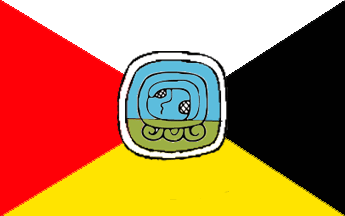
 Classic Maya (Mayan family)
1. Introduction to Classic Maya
“Mayan” is not a single language but a family of about thirty languages spoken across southern Mexico, Guatemala, Belize and Honduras. The script of the ancient Maya — the famous hieroglyphs of the Classic period (c. 250–900 CE) — records mainly a prestige language related to the Ch'olan branch, sometimes called Classic Maya or Classic Ch'olti'an.1
Mayan languages are very much alive: around six million people speak Mayan languages today (Yucatec, K'iche', Q'eqchi', Mam and many more).
A note on the name
Like “Eastern Algonquian,” “Mayan” names a family, not one language. This guide is an honest orientation to that family and to the Classic-period hieroglyphic language — not a single fabricated “Mayan” course. Community review is required.
2. Historical context
The Classic Maya built a literate civilisation whose inscriptions on stone and in bark-paper books record dynastic history, ritual and astronomy. The Maya script was largely deciphered only in the later 20th century (Knorozov, Proskouriakoff, and many Maya and non-Maya scholars since).
3. Writing system
The Maya script is a logo-syllabic writing system — one of the few fully developed indigenous writing systems of the Americas — combining word-signs (logograms) with a syllabary. Reading it requires specialist training, and interpretation is still advancing.
4. A few words
Reading glyphs is specialist work; only very well-attested items are given here.
| Classic Maya | Meaning | Note |
|---|---|---|
| ajaw | lord, ruler | very well attested in inscriptions |
| k'uh / k'uhul | god, holy | as in k'uhul ajaw, “holy lord” |
| b'aah | head; self, image |
5. Learning resources
A recommended starting stack — including living-community resources:
- Kettunen & Helmke, Introduction to Maya Hieroglyphs (free PDF, Wayeb)Beginner — the standard free introduction to the script
- Coe & Van Stone, Reading the Maya Glyphs — accessible introduction
- Mayan languages — overview — the ~30-language family and its living communities
Where this guide is going
This orientation explains that “Mayan” is a family, introduces the hieroglyphic script and a few securely-read words. A fuller treatment — of the script, and/or of a specific living Mayan language — must be developed with community and expert input; it is marked incomplete on purpose.
6. Honest limitations
- “Mayan” is a family of ~30 languages, not one language; treating it as a single course would misrepresent it.
- Mayan languages are living Indigenous languages (~6 million speakers): this guide requires community and expert review before publication.
- Reading the hieroglyphic script is specialist work and interpretation is still advancing.
- This guide is an orientation stub; a full treatment is not yet built.
⚑ Requires community/expert review before publication (living Indigenous language family + specialist script). Learners should be pointed toward living Mayan-language communities and qualified epigraphy courses.