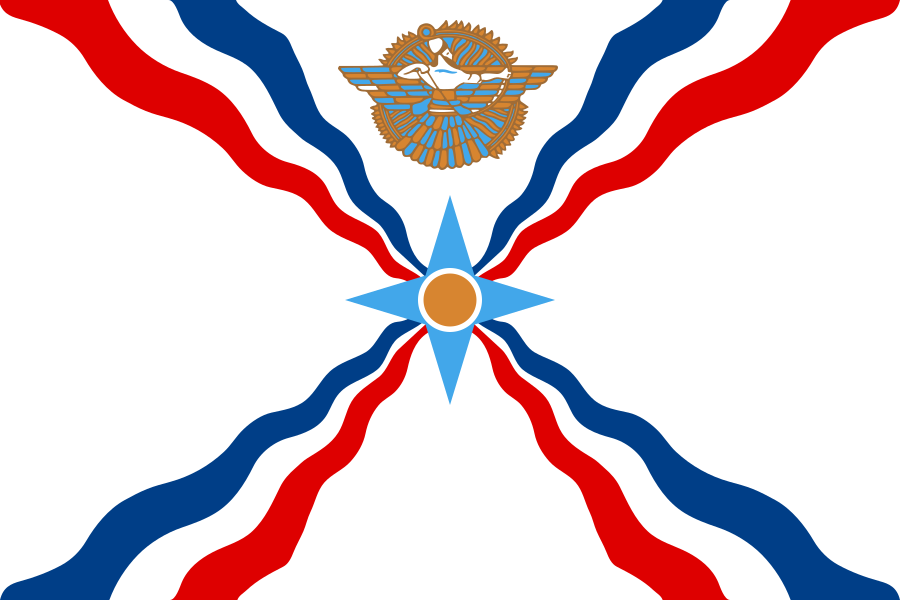
 Ancient Assyrian (Akkadian)
1. Introduction to Ancient Assyrian
“Ancient Assyrian” refers to the Assyrian dialect of Akkadian, the East Semitic language of ancient Assyria and Babylonia, written in cuneiform. Akkadian is attested from around 2500 BCE and was the great international language of the ancient Near East.1
Assyrian and Babylonian are the two main dialects of Akkadian; scholars distinguish Old, Middle and Neo-Assyrian phases (c. 2000–600 BCE).
A note on the name
This is a crucial disambiguation: ancient Assyrian (a dialect of Akkadian) is NOT the same as the modern language of the Assyrian people, which is a Neo-Aramaic language (often called Assyrian Neo-Aramaic or Suret) still spoken today. This guide is about the ancient cuneiform language, not the living one.
2. Historical context
Akkadian, named for the city of Akkad, spread with the Akkadian and later Assyrian and Babylonian empires and served as a diplomatic lingua franca (as seen in the Amarna letters). It was gradually displaced by Aramaic in the first millennium BCE.
3. Writing system
Written in cuneiform, borrowed and adapted from Sumerian — a logo-syllabic script on clay. Pronunciation is reconstructed from the script and comparison with other Semitic languages.
4. A few words
A few Akkadian words (conventional readings):
| Akkadian | Meaning | Note |
|---|---|---|
| šarru | king | cf. Hebrew sar |
| bītu | house | Semitic *bayt- |
| mû | water | |
| ilu | god | cf. Hebrew El |
| awīlu / amīlu | man, person |
5. Learning resources
A recommended starting stack:
- John Huehnergard, A Grammar of AkkadianBeginner — the standard teaching grammar
- The Chicago Assyrian Dictionary (CAD), free PDFs — the monumental Akkadian dictionary
- Akkadian language — overview — dialects (Assyrian/Babylonian), cuneiform
Where this guide is going
This orientation covers what ancient Assyrian/Akkadian is (and how it differs from the living Assyrian Neo-Aramaic language), its script and a few words. A fuller course (the cuneiform syllabary, Semitic roots, the case system) is planned and marked incomplete for now.
6. Honest limitations
- Do not confuse this with modern Assyrian (a living Neo-Aramaic language) — they are different languages separated by millennia.
- A reading language requiring cuneiform; pronunciation is reconstructed.
- This guide is an orientation stub; the full course is not yet built.